Health & Fitness
Cahors: The Truth and Roots of Malbec Wine
French Malbec wines grew in France before Argentina.

Many people love Malbec red wine, both for its flavor and for its price.
Although Malbec is now associated with Argentina, it first grew in France. Remember, France is an Old World grape growing country and Argentinia is New World. This means that France was growing wine grapes back when wine was first being made, whereas Argentina is new to the art of wine making.
The reason why you may not know this is two-fold. First, only Cahors in France now grows Malbec grapes and, second, France puts the location of the wine - not the grape - on the label. So, unless you know that Cahors grows Malbec, you may not know that it is, in fact, a Malbec wine. Below are some examples of Cahors Malbec wines.
Find out what's happening in Prospect Heights-Crown Heightswith free, real-time updates from Patch.
Pigmentum by George Vigouroux, Cahors France, 2011
It is a deep purpley red and smells of cooked red fruits, the same smell as when someone is baking a pie or making jam with a variety of red fruits. The flavor is a blend of fruits without being a “fruit bomb," the tannin keeps the wine structured.
Find out what's happening in Prospect Heights-Crown Heightswith free, real-time updates from Patch.
During the finish, I tasted a touch of plum and, overall, this wine was typical of Malbec to me. People like Malbec because it is “smooth” or has no “bite," and this wine matches that description. I enjoyed it by itself and with sharp cheddar cheese.
Clos Triguedina, Cahors France, 2008
A great garnet purpley-red color smelling slightly metallic and funky, this Malbec has tannin that will affect your inner lip and gums, but will not attack your whole mouth. Typical of a French wine, the fruitiness is balanced with complexity and depth. This wine is nothing like Argentinian Malbecs because it doesn’t have the smooth “goes down easy” feeling you get from Argentina, nor the fruitiness. It is a wine designed for heavy and fatty winter meals that keep you going like steak or something make with dark chocolate or cheese.
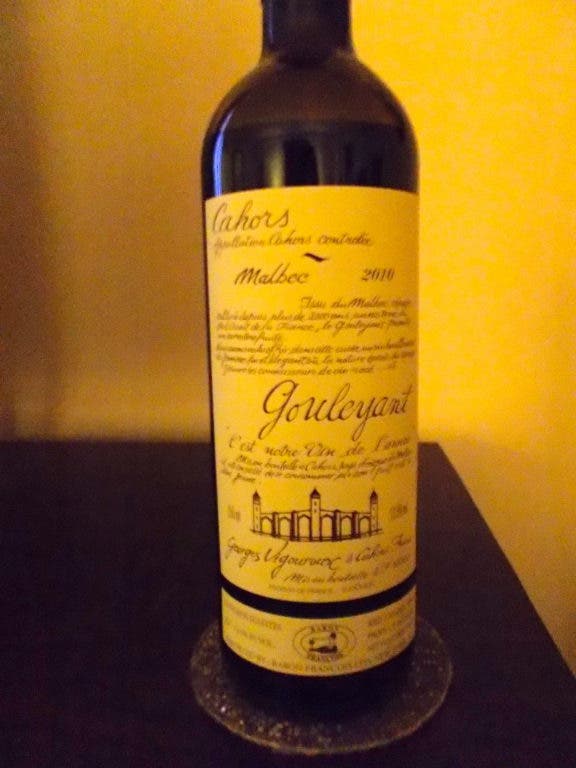
Gouleyant, Cahors France, 2010
This wine has one of the busiest labels I’ve ever seen, but at least it tells you it is a Malbec. The description is in French, so if you don’t read French, the label indicates it wants to give you fruitiness in the flavor, liveliness, youth and elegance. It smelled of cooked fruit and darker colored fruits and had the trademark dark purple-red color of Malbec. Full of dark fruit flavors such as cassis, the body and flavor are not so overwhelming that you don’t want more. Flavorful meats such as lamb with rich sides like yams would go well with this wine. Foregoing the Argentinian fruitiness, you taste a rich complexity in this wine.
Clos Siguier, Cahors France, 2009
The grapes for this wine were grown on 80-year-old vines and is 100 percent Malbec. The grapes are hand-picked and sustainably grown. Foregoing the overpowering heaviness of other French Malbec wines, this wine is smooth and elegant. There is no overpowering fruitiness, but rather a great balance in this wine. This wine will let you know that if you think you know all the good sides of Malbec, you don’t yet. Old, aged cheese, creamy foods, chocolate and other rich foods pair well with this wine. As usual, you will see deep purple-red colors in this wine. It was my second-favorite of he Cahors wines.


